BFF Frontend Architecture: Why It Keeps Complex UIs Sane
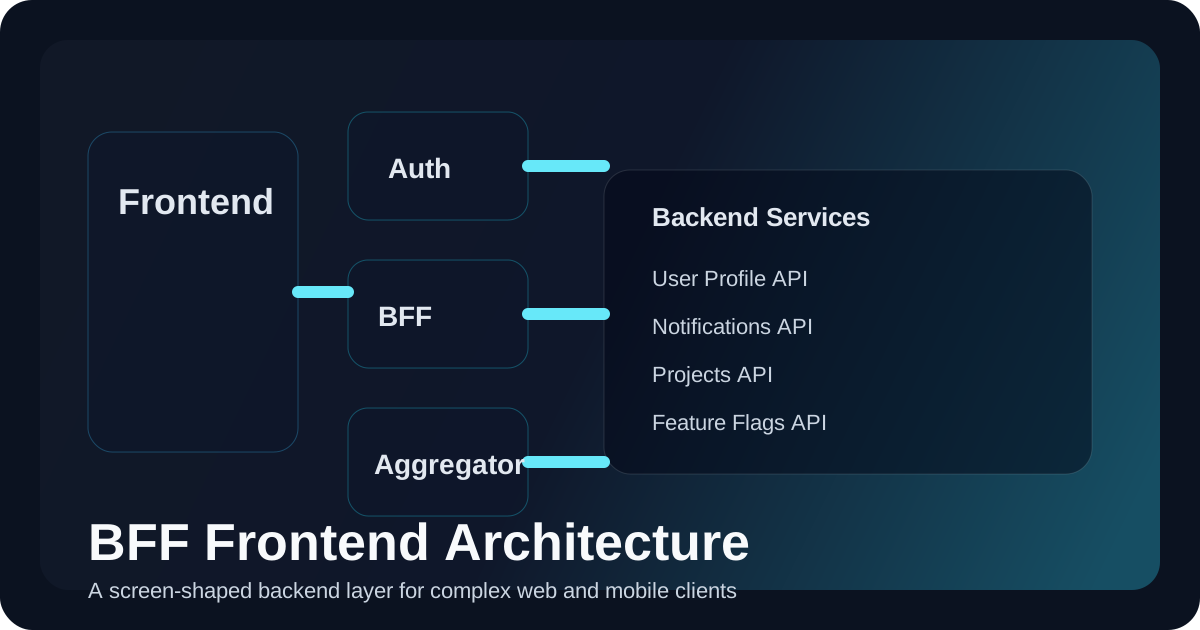
Table of Contents
The Backend-for-Frontend pattern is one of the most useful architectural tools for modern product teams. It gives each frontend surface a backend layer that is shaped around its exact needs instead of forcing the UI to orchestrate multiple generic services on its own.
Why the BFF pattern exists
In many products, the frontend needs data from several services at once. Without a BFF, the browser ends up stitching together calls to auth, user profile, notifications, entitlements, billing, and feature flags. That makes the frontend heavier, slower, and harder to reason about.
A BFF gives the UI one purpose-built integration point. It can aggregate data, hide service boundaries, normalize inconsistent payloads, and reduce chatty round trips into a single request that better matches the screen the user actually sees.
What a BFF usually does
- Aggregates data from multiple backend services into one screen-shaped response.
- Applies frontend-specific authorization and feature gating.
- Adapts payloads so web and mobile clients do not each duplicate mapping logic.
- Handles retries, caching, and partial-failure behavior in one place.
- Keeps internal service topology out of the browser.
A simple mental model
Think of domain services as being optimized for business capabilities, while the BFF is optimized for user experience delivery. The service layer answers domain questions. The BFF answers page and interaction questions.
// Example: one endpoint shaped for a dashboard screen
export async function getDashboardView(userId: string) {
  const [profile, notifications, projects] = await Promise.all([
    profileService.getProfile(userId),
    notificationService.getUnread(userId),
    projectService.getRecentProjects(userId),
  ]);

  return {
    user: {
      name: profile.name,
      role: profile.role,
      avatar: profile.avatar,
    },
    unreadCount: notifications.total,
    recentProjects: projects.items,
  };
}
When BFF is a good fit
BFF works especially well when you have multiple clients with different needs, such as web, admin, and mobile. It is also valuable when service boundaries are stable but UI requirements change quickly, because the BFF becomes the adaptation layer between those two rates of change.
Tradeoffs to watch
BFF is not free. It adds another deployable unit, another ownership boundary, and another place where business logic can accidentally drift. The pattern works best when you keep domain rules in core services and reserve the BFF for composition, shaping, and client-oriented orchestration.
Practical checklist
- Keep the BFF close to the frontend team that owns the experience.
- Do not duplicate domain rules that should stay in platform services.
- Shape responses around user journeys, not database entities.
- Centralize caching, feature flags, and resilience logic where it helps the client.
- Measure whether the BFF actually reduces frontend complexity and request cost.
Final takeaway
BFF is most effective when the UI is moving fast and the service landscape is already split across multiple domains. Used well, it lowers frontend complexity, improves performance, and gives teams a safer place to adapt backend systems to real product workflows.